
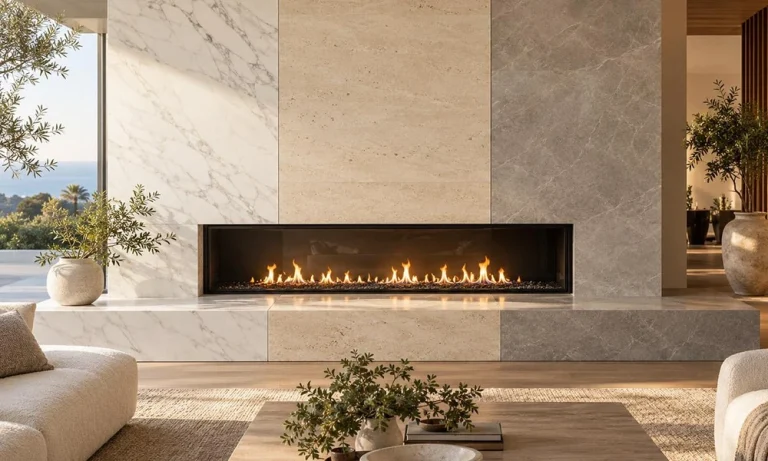
How natural stone slabs and porcelain handle heat, soot, seams, and hearth wear around today’s linear gas fireplaces and classic mantels.
Maybe you just picked out a sleek linear gas fireplace, or the 1990s brick surround in your living room is finally ready to go. Either way, you are about to walk into a slab yard full of natural stone slabs Orange County homeowners love, plus porcelain that looks just like them. At Trendy Surfaces, we help clients make this call every week in our Irvine and Laguna Niguel showrooms. This guide covers heat, soot, seams, hearth wear, and style for the surround itself. If you are planning a full stone wall, see our full-height feature wall ideas instead.
Key Takeaways
- Marble, limestone, soapstone, granite, and porcelain slabs are all noncombustible, but your fireplace manual and local code decide where each can go and how close wood trim can sit.
- Limestone and most marbles are acid-sensitive, so smoke residue and harsh cleaners can dull them, which makes honed finishes and gentle cleaning worth considering.
- Large porcelain slabs (some about 126 x 63 inches) can cover a modern linear fireplace with few or no seams and no sealing.
- The hearth takes the most wear, so a denser stone or porcelain there is a smart choice, or you can plan to enjoy the patina a softer stone develops.
- Bring your fireplace model number and opening dimensions to the slab yard so the surround can be laid out and quoted correctly from the start.
Can Natural Stone Slabs Go Around a Fireplace? Heat and Clearance Basics
Yes. Stone and porcelain are noncombustible, which is why they are the usual choice for the area right around a firebox. But the stone does not set the rules. The type of fireplace you have and its installation manual decide what can go where and how close any wood can sit.
What “noncombustible” means in plain language
A noncombustible material will not catch fire or feed a fire. That is not the same as being immune to heat: stone can still expand, discolor, or crack if installed without the gaps and backing the fireplace maker calls for.
Masonry vs. factory-built and gas units
Traditional masonry fireplaces (built on site from brick or block) follow code numbers. According to Fine Homebuilding’s summary of fireplace clearance codes, combustible trim generally needs to stay about 6 inches from the opening, and a projecting wood mantel about 12 inches above it. Inside that zone, trim can only stick out a small amount for each inch of distance.
Factory-built and gas fireplaces are different. They follow their own tested, listed clearances, which can be tighter or looser than the masonry rules. For example, one linear gas fireplace manual requires noncombustible cement board around the opening and warns that the wall above can get hotter than 200°F. Those numbers apply to that model only.
The hearth extension
Wood-burning fireplaces also need a noncombustible hearth extension, the strip of floor in front of and beside the opening. Its required size depends on the size of the firebox opening. California’s version of these rules is close to the national model code, as this California Residential Code excerpt shows, but local amendments exist. Confirm hearth and trim requirements with your installer, your fireplace manufacturer, and your city’s building department before you finalize a design.
The stone sets the style, but the fireplace manual and your local code set the rules.
Marble Fireplace Surrounds: Classic Veining, Softer Surface
Marble delivers the most dramatic look of any surround material, and it works on both sleek bookmatched walls and carved traditional mantels. The trade-off is chemistry. Marble is calcareous (rich in calcium), so acidic cleaners and smoke residue can etch, or dull, its surface over time.
Where marble shines
Designers often reach for marble slabs first. A bookmatched pair, two slabs cut side by side and opened like a book so the veining mirrors itself, makes a striking frame for a linear gas unit. Softly veined white marbles also suit classic mantels with a timeless, Calacatta-inspired feel.
Finish choice for fireplaces
A polished finish is glossy and reflective. A honed finish is smooth but matte, more like a soft satin. Around a fireplace, honed marble tends to be more forgiving because light etching and the marks left by soot cleanup blend in instead of catching the light.
The Natural Stone Institute’s care guidance recommends a neutral, pH-balanced cleaner or stone soap for calcareous stone. It also notes that smoke-stained fireplace stone may need a deep cleaning and, in some cases, professional refinishing.
Limestone Surrounds: Soft, Warm, and Made for Traditional Mantels
Limestone has a quiet, even tone that feels warm in almost any light. It is a natural match for the French and Mediterranean-style mantels found in many older South Orange County homes. The limestone slabs in our collection lean toward soft creams, warm grays, and gentle fossil texture rather than bold veining.
Porosity and soot
Limestone is generally more porous than marble, which means it absorbs liquids and residue more easily. A penetrating sealer, which soaks into the stone rather than sitting on top, helps it resist stains, but it will not make limestone stain-proof. The encouraging news for many Orange County homes is that gas fireplaces leave far less soot than wood-burning ones.
Carved vs. slab-clad
Limestone carves beautifully, so it is a favorite for traditional mantels with corbels, moldings, and detailed legs. Slab-clad limestone, where flat panels wrap the surround, gives the same warmth in a cleaner, more contemporary form. Both can work, as long as any wood mantel above stays at the clearances your manual allows.
Porcelain Slabs vs. Natural Stone Slabs in Orange County Homes
Porcelain slabs give you a marble or limestone look with very low porosity, no sealing, and huge formats that cut down on seams. The main trade-off is that the pattern lives mostly on the surface, so edges and corners need careful detailing to look like solid stone.
Our large-format porcelain slabs are a popular pick for Trendy Surfaces clients who want a busy family room to stay low maintenance.
Low upkeep for gas fireplaces
Porcelain shrugs off most stains and wipes clean with a damp cloth. One manufacturer’s porcelain slab FAQ lists fireplace surrounds as an approved use, describes its slabs as non-porous with no sealing needed, and gives a size of about 126 x 63 inches. That is large enough to wrap many linear fireplace walls with one or two pieces.
Edge and miter detailing
Many porcelain slabs have a color body, meaning the clay is tinted to match the surface, but the veining does not run all the way through. On an exposed edge, you may see the plain body instead of the pattern. A mitered edge, where two pieces meet at a 45-degree angle, carries the look around the corner. A tiny micro-bevel (a slightly softened edge) at that miter helps prevent chipping.
Slab Sizing, Seams, and Layout for Linear and Traditional Fireplaces
Every good fireplace layout starts with a tape measure, long before anyone falls for a slab. Measure the full surround, the hearth, and any side returns, because slab size decides where seams will land.
A typical linear fireplace wall may need one large slab or a bookmatched pair. A smaller traditional surround can often come from a single slab or even a remnant.
Planning seams around the firebox opening
Keep seams out of the hottest area just around and above the opening when possible, and line them up with the veining so they read as part of the design. Movement joints, small gaps that let materials expand and shrink with heat, go where your installer and fireplace manual call for them.
What to bring to the slab yard
Our guide on what to bring to your slab yard appointment covers the basics. For fireplaces, add these:
- The fireplace make and model number, or its installation manual
- Opening width and height, plus the overall wall size
- Photos of the current fireplace and room
- Mantel plans, including material and height
Hearth Durability: Choosing Natural Stone Slabs That Handle Logs, Feet, and Heat
The hearth is the hardest-working part of any fireplace. It catches dropped logs, scraping tools, and kids who use it as a bench, all while sitting closest to the heat. A stone that looks perfect on the wall may wear faster underfoot, so it is worth choosing the hearth on its own merits.
Your hearth works harder than your surround, so choose the toughest surface for the floor.
Denser options
Granite is hard and siliceous, meaning it is made mostly of silicate minerals that resist most household acids, so it handles soot and cleaners better than marble or limestone. Soapstone is another classic hearth stone. According to one stove maker’s guide to soapstone, it soaks up heat, releases it slowly, handles big temperature swings, and darkens gradually with use.
Mixing materials
You don’t need one material for everything. A bookmatched marble or porcelain surround paired with a tougher granite or soapstone hearth gives you the look up high and the durability down low. Our team at Trendy Surfaces can pull slabs side by side so you can see how the colors work together.
Matching the Surround to Your Fireplace Style
Modern linear gas fireplaces look best with large-format, low-seam slabs in either quiet or boldly bookmatched patterns. Traditional fireplaces suit limestone or softly veined marble, often with a carved stone or wood mantel set at the clearances your manual and local code allow.
Modern Orange County living rooms
Floor-to-ceiling slabs and a recessed TV niche are common in newer Irvine-area and coastal homes, and porcelain or bookmatched marble keeps the look clean. If you plan a TV above the fireplace, remember that the wall above some units can get very hot, as that linear gas manual notes, so check your model’s guidance on electronics placement.
Traditional and transitional
A limestone or marble surround with a painted or stained wood mantel above is a timeless pairing. For masonry fireplaces, that mantel generally needs to sit about 12 inches above the opening, but factory-built units can differ. Your manual is the final authority.
Material availability, pricing, and lead times vary by project and are confirmed in-showroom or by quote.
Conclusion: Choosing Natural Stone Slabs in Orange County for Your Fireplace
Think about a fireplace surround in two steps. First, your fireplace manual, installer, and local building department set the heat and clearance rules. Then the material choice comes down to upkeep versus look. Marble and limestone bring natural depth and character but ask for gentle care, while porcelain trades a bit of authenticity at the edges for nearly zero maintenance.
Ready to see these materials in person? The team at Trendy Surfaces has been helping Orange County homeowners, designers, and contractors find the right stone and porcelain slabs for fireplaces and hearths.
Visit the Irvine Slabyard & Showroom at 17912 Cowan, Unit C, Irvine, CA 92614, or call (714) 284-0118. Or stop by the Laguna Niguel Design Center at 23811 Aliso Creek Road, Ste 176, Laguna Niguel, CA 92677, or call (949) 446-8121.
Frequently Asked Questions
Is marble safe to use around a gas fireplace?
Marble is noncombustible, so it is commonly used around gas fireplaces. Your fireplace’s installation manual still decides what backing, gaps, and clearances are required, so follow it closely.
How close can a wood mantel be to a fireplace opening?
For traditional masonry fireplaces, model codes generally call for a projecting wood mantel to sit about 12 inches above the opening, with smaller trim allowed closer. Factory-built gas fireplaces follow their own tested clearances, which can differ. Always confirm with your fireplace manufacturer and your local building department.
Will soot stain a limestone or marble fireplace surround?
It can. Limestone and marble are acid-sensitive and somewhat porous, so smoke residue can stain or dull them, especially around wood-burning fireplaces. A penetrating sealer and a neutral, pH-balanced stone cleaner help, and heavy smoke damage may need professional cleaning or refinishing.
Do porcelain slabs need sealing on a fireplace surround?
Generally, no. Most porcelain slabs are made to be non-porous, so they resist stains without a sealer and wipe clean easily. Check the specific product’s care guide, and follow your fireplace manual for installation details.
What is the best stone for a fireplace hearth that gets heavy use?
Granite and soapstone are two of the most durable choices for a busy hearth. Granite is hard and resists most household acids, while soapstone handles heat well and develops a darker patina over time. Porcelain is also a strong, low-maintenance option if you prefer a marble or limestone look.